HapTone is a tuner project designed with blind and visually impaired musicians in mind. The idea is simple: find the right note without watching a needle or a screen. We are exploring vibration, voice and sound as ways to communicate the pitch being played.
This article is a project update as of May 2026. HapTone was first introduced in June 2025 in our first article about the HapTone project; since then, the project has entered hardware and software prototyping in collaboration with Polytech’ Paris-Saclay. Two students from the school, Manuelle Wafeu and Yannis Ngako, supervised by Amine Khettat (CEO of Blind Systems, who proposed the project to the school), defended in April 2026 a mini-project dedicated to HapTone. They presented the functional architecture, hardware integration and signal-processing pipeline detailed below.
The problem: a simple gesture made inaccessible
Many tuners display pitch accuracy through a needle, LEDs or a screen. That information can be difficult to use without sight. Tuning by ear and apps that work with screen readers already offer useful options, depending on the instrument and the musician. HapTone explores another approach: feedback that can be felt or heard directly.
In rehearsals and classrooms, nearby sounds can interfere with pitch measurement. The project therefore compares acoustic capture with a sensor attached to the instrument. Tests on different instruments and in real playing conditions will help establish whether the feedback remains clear and useful.
Our solution: multi-sensory tuning
The proposed architecture includes three forms of feedback, to be evaluated with musicians:
- Haptic vibration — a vibration motor driven by a haptic driver, the DRV2605L from Texas Instruments, encodes pitch accuracy as distinct patterns (short pulse = too low, long pulse = too high, brief confirmed pulse = in tune).
- Voice synthesis — the system announces the note name and the deviation in cents, through a speaker.
- Audio tone — a continuous reference tone modulates its frequency depending on the deviation.
Sound acquisition: MEMS microphone or piezo sensor, your choice
- 24-bit MEMS I2S microphone — standard acoustic capture, ideal for quiet environments, wind instruments and voice.
- Piezoelectric sensor (SEN-VIB01) — direct contact with the instrument. It measures vibrations transmitted by the instrument. This may reduce the influence of some surrounding sounds; its effectiveness still needs to be measured for different mounting positions and playing conditions.
Functional architecture
The prototype uses an Espressif ESP32-S3, with two cores, vector instructions useful for signal processing, Wi-Fi and Bluetooth Low Energy. Under FreeRTOS, audio acquisition, pitch estimation and user feedback are organised as tasks. A quick response is a design goal. End-to-end latency must be measured on the integrated prototype; this architecture alone does not guarantee a response below 50 ms.
Product design: two approaches under discussion
Two configurations are still being considered. They come with different constraints on size, battery life, cost and handling. We want an adapted accessory to be affordable without requiring expensive extra equipment. Tests and feedback from musicians should guide that choice.
Configuration A — Standalone tuner (built-in vibration motor and speaker)
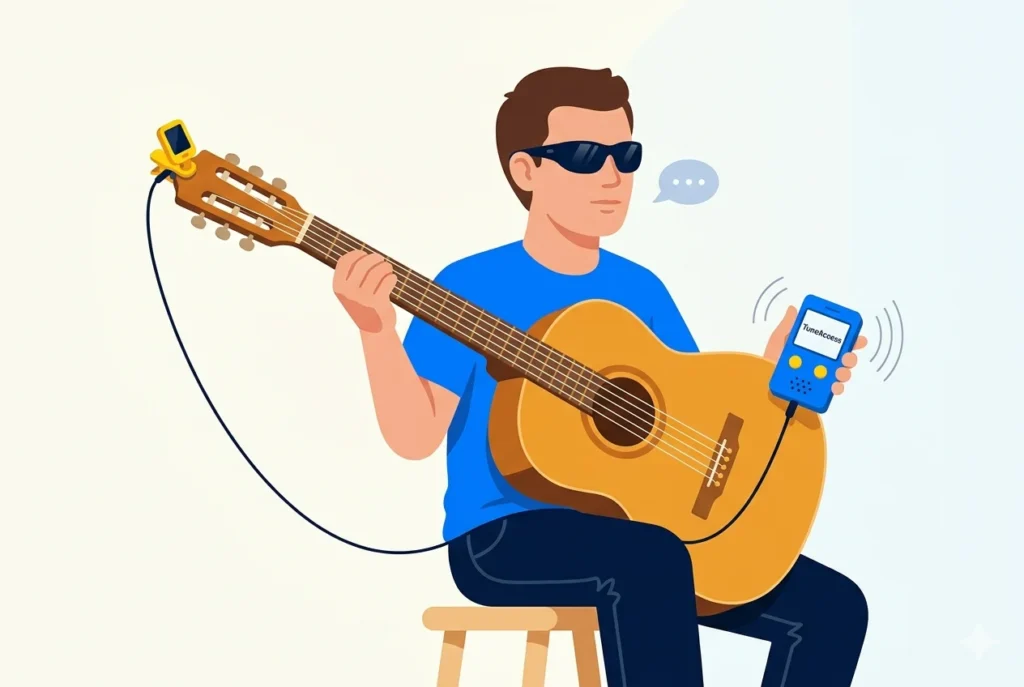
- Pros: no smartphone needed; feedback would come directly from the unit, including for musicians who prefer to keep their phone away while playing.
- Cons: a potentially larger enclosure and higher component cost for the vibration motor, speaker and battery; battery life remains to be measured.
Configuration B — Minimal clip paired with a smartphone (Bluetooth)
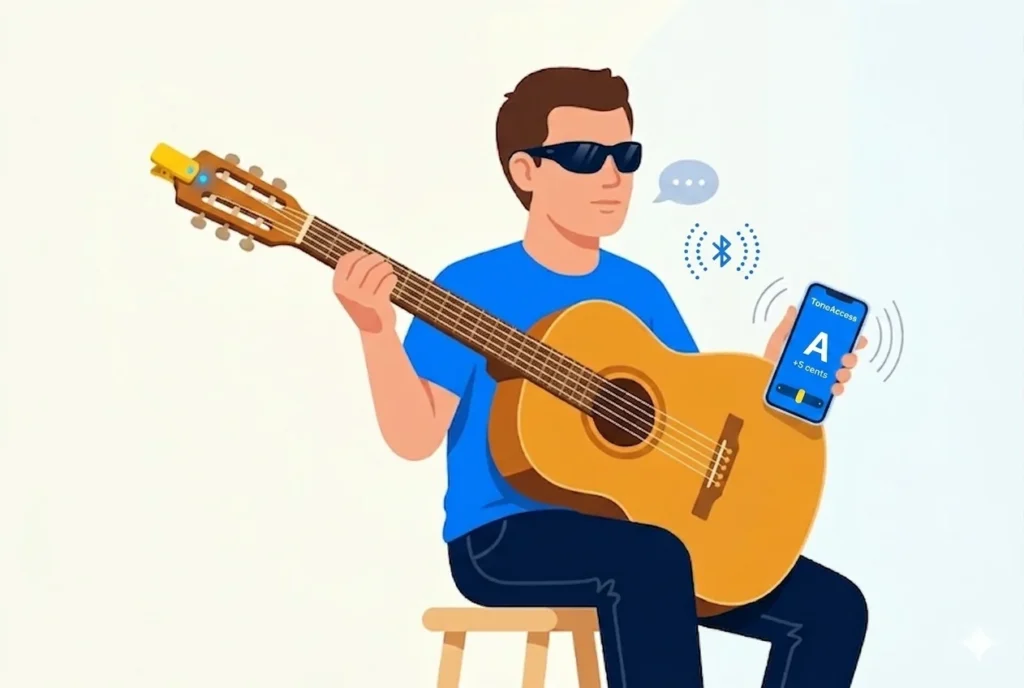
- Pros: a potentially smaller enclosure, component cost to be compared, the smartphone provides vibration and speaker, the dedicated app can evolve independently of the firmware.
- Cons: smartphone required, Bluetooth pairing step, latency depends on the phone, the user depends on a third-party device to play.
HapTone Solo and HapTone Mini are working names for these two approaches, not an announcement of available products. Would you prefer a standalone device or an accessory connected to your phone? Your playing habits and the difficulties you encounter will help us decide.
Demo: piezo-sensor pitch detection
This demonstration from the Polytech team shows pitch detection with a piezo sensor in contact with a string. It illustrates one stage of the prototype; it does not, by itself, establish accuracy in every environment.
Demo: MEMS I2S-microphone pitch detection
This second demo illustrates pitch detection in acoustic mode through a MEMS microphone, useful for wind instruments and voice.
Pitch detection with YIN
The Polytech team selected YIN, described by Alain de Cheveigné and Hideki Kawahara in their 2002 paper. It estimates the periodicity of a signal using a difference function, normalisation and a threshold, then refines the estimate through interpolation. Accuracy depends on the signal, the parameters and the analysis window. Project tests need to document these choices and their limits. The estimated frequency is then converted into a note and a deviation in cents, using a tuning reference such as A4 = 440 Hz.
Who is it for?
- Blind and visually impaired musicians.
- Music students with adapted curricula.
- Professionals in noisy environments (stage, studio, rehearsal room).
- Inclusive music education teachers and institutions.
Development status
This update presents prototyping work on acquisition, pitch detection and user feedback. Before a possible finished product, several steps remain: choosing a configuration, integrating the circuit and enclosure, developing a companion app if needed, user testing and the applicable conformity requirements. Performance and battery life will need to be documented on an integrated version.
Sharing the work and contributing
We want the work to be reusable and welcome contributions. To request the available project files and learn about their reuse terms, contact us. The resources released and their licences need to be specified for each version.
Join us: contributors, volunteers and patrons
- Embedded developers (ESP-IDF, FreeRTOS, DSP)
- Hardware designers (PCB, enclosure, mechatronics)
- Mobile developers (iOS, Android, accessibility)
- Musician testers
- Patrons and institutional partners — HapTone is currently personally funded by Amine Khettat (CEO of Blind Systems), pending support from patrons or institutional grants. Your contribution will help accelerate industrialisation and deployment to schools and conservatories.
- Communication, translation and documentation volunteers
To contribute, email us or use the contact form:
Tell us about your background, your availability and how you would like to contribute — we will get back to you quickly.
HapTone is a project by Blind Systems, an engineering and innovation lab. This article presents work with Polytech’ Paris-Saclay on a practical question: how to tune an instrument without relying on sight.